
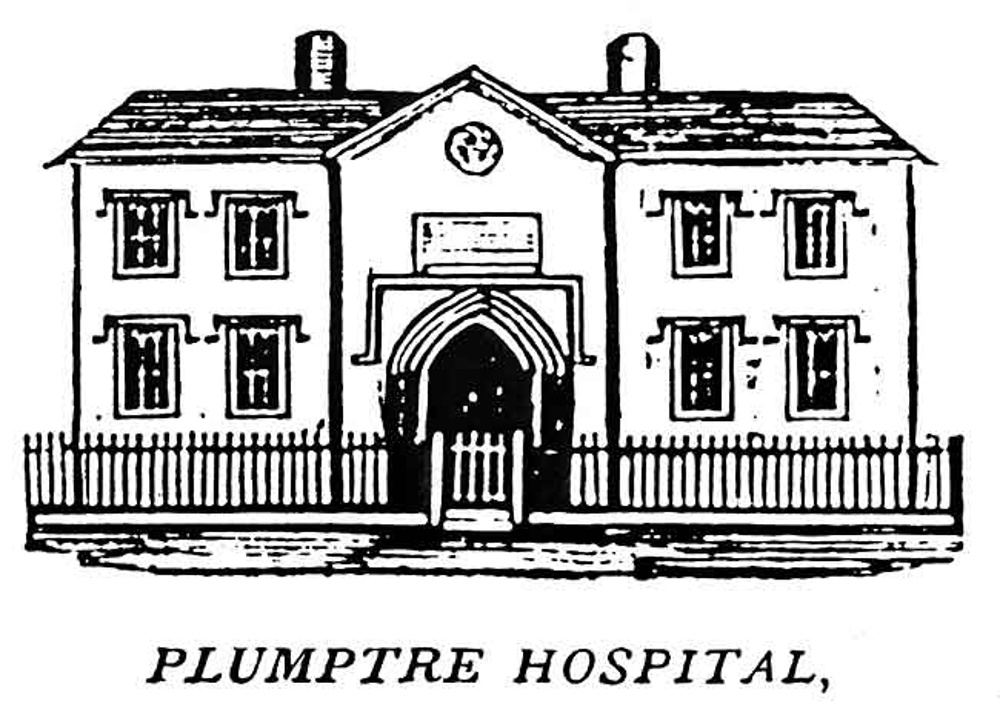
‘QUITE AN ORNAMENT TO THAT PART OF THE TOWN .. . light, airy, and comfortable’.
Edward Staveley’s new Plumptre Hospital of 1823, as depicted in the ‘Stranger’s Guide.’
In 1392 John de Plumptre, a merchant of the staple of Calais who traded mainly in wool and was four times mayor of Nottingham, was granted a licence by King Richard II to found and endow a hospital or house of God for two chaplains and thirteen poor widows ‘bent by old age and depressed by poverty.’
The hospital was more of an almshouse than a hospital and dedicated to the Blessed Virgin Mary and was endowed with 13 properties around the town of Nottingham. The priest was instructed to pray for John, his wife Emma, the king, the people of Nottingham, and all the Christian dead — especially those who gave to the hospital.
In 1414 the number of widows was reduced to seven and John gave the hospital his house, an imposing residence with gardens stretching down to St. Peter’s. The Flying Horse Hotel now occupies the site. The hospital was one of the few charities to escape the dissolution by Edward VI. in 1547 when the endowments of nearly all charitable institutions were swept away.
The hospital was almost in a state of ruin when it was renovated by Huntingdon Plumptre, a physick, in 1650. The good doctor raised the rents of the hospital’s properties which enabled the charity to give the widows an allowance of five shillings per month with an additional sixpence at New Year.

The Plumptre Hospital after Huntingdon Plumptre’s rebuilding of 1650, from Robert Thoroton’s ‘Antiquities of Nottingham.’
In 1753 the hospital was extended by John Plumptre, presumably the father of the first John Plumptre of Fredville, and the 13 widows’ allowance was increased to £13 10s; a gown; and a tonne of coal annually with an additional sixpence at New Year.

A 1750 engraving of the hospital building
After John Plumptre, who had been M.P for Nottingham from 1762 to 1774, gave up his Nottingham residence and went to live at Fredville Park in Kent at the beginning of the 19th century the family continued to maintain the charitable institution. In August of 1823 a new hospital was built on the site of the old one.
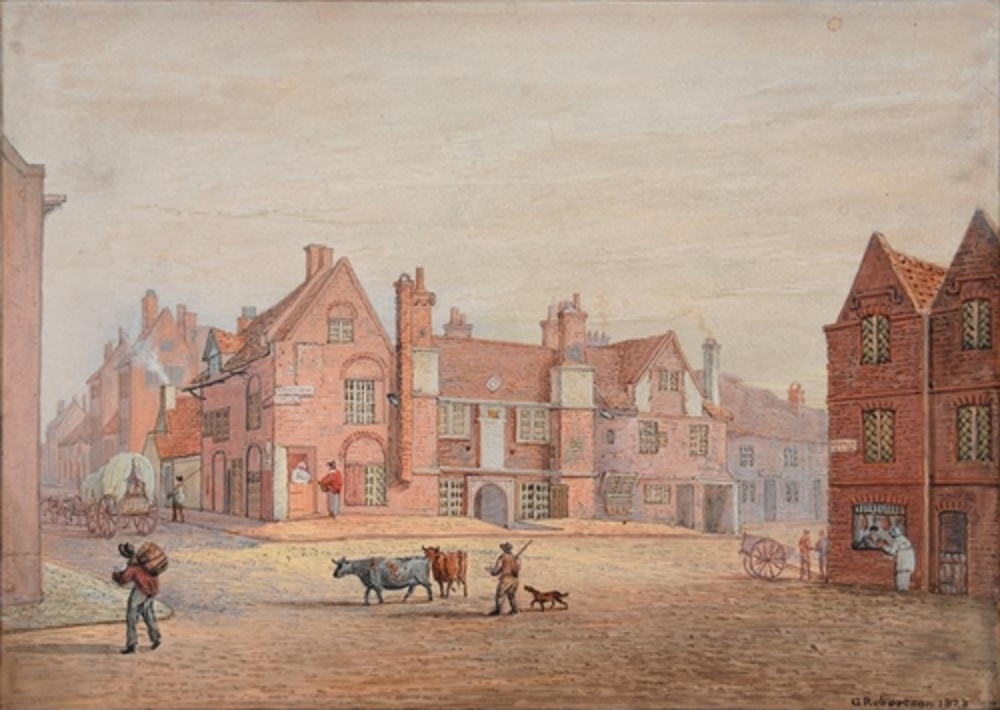
The Plumptre Hospital, Nottingham by George Robertson. The picture is dated 1823, so must have been completed just before the building was demolished to make way for the new hospital
The first stone of the new hospital building was laid by the Rev. Charles Thomas Plumptre, Rector of Claypole in Lincolnshire on behalf of his father, “John Plumptre, of Fredville, in the county of Kent, Esq., the Master or Guardian of the said Hospital. And a descendant of the Founder”.

The commemorative stone shown above reads:-
Founded and endowed for the support of a Master, a priest, and thirteen poor Widows,
By John de Plumptre, A.D. 1392.
Repaired by Huntingdon Plumptre, Esq., 1650
By John Plumptre, Esq., A.D. 1751
By John Plumptre, his son, A.D. 1753.
First stone of the present Hospital was laid on the 1st of August, A.D. 1823,
By the Rev. Charles Thomas Plumptre, Rector of Claypole,
In Lincolnshire, on behalf of his father, John Plumptre, of Fredville,
In the county of Kent, Esq., the Master or Guardian of the said Hospital,
And a descendant of the Founder.
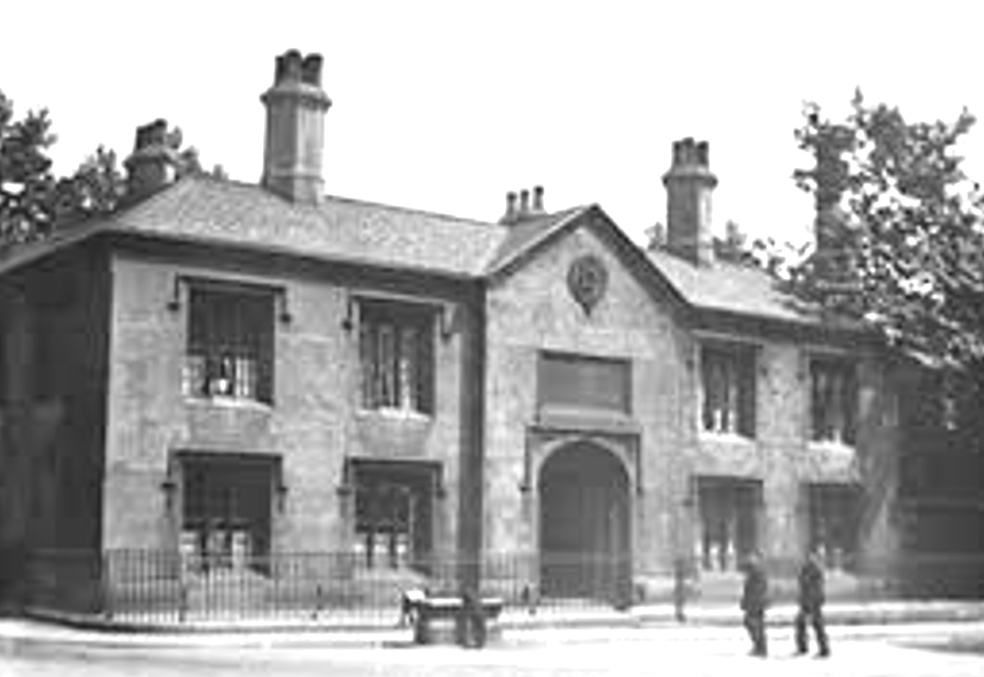
An 1844 photograph of the not long built Plumptre Hospital.
+++
When John Pembleton Plumptre of Fredville died in 1864, the absence of a male heir meant that Fredville and other property was inherited by his nephew, Charles John Plumptre, the eldest son of his brother, the Reverend Charles Plumptre of Claypole.


The charity built a second set of almshouses was built in Canal Street in 1956. By 1991 the charity was unable to maintain the hospital building and the residents were moved to other almshouses, 599 years after the founding of the charity, and the building remained empty until it was taken over by the Royal National Institute for the Blind in 2001.
The charity, with family members as trustees, continues to distribute alms to the present day and has some thirty out-pensioners.
+++
For a comprehensive history of the Plumptre Hospital in Nottingham I highly recommend


Thanks for the information. The Plumptre family of Fredville have the living of the parish of Claypole.
I have written the history of beekeeping in Victorian Nottingham. During my research I found the following in the British Beekeeping Journal dated 24 August 1884. I wonder if it is any use to you?
“Lincolnshire Beekeeping Association show – Best 12 1-lb sections of comb honey in crate – Rev Chas Plumtree, Claypole, Newark”