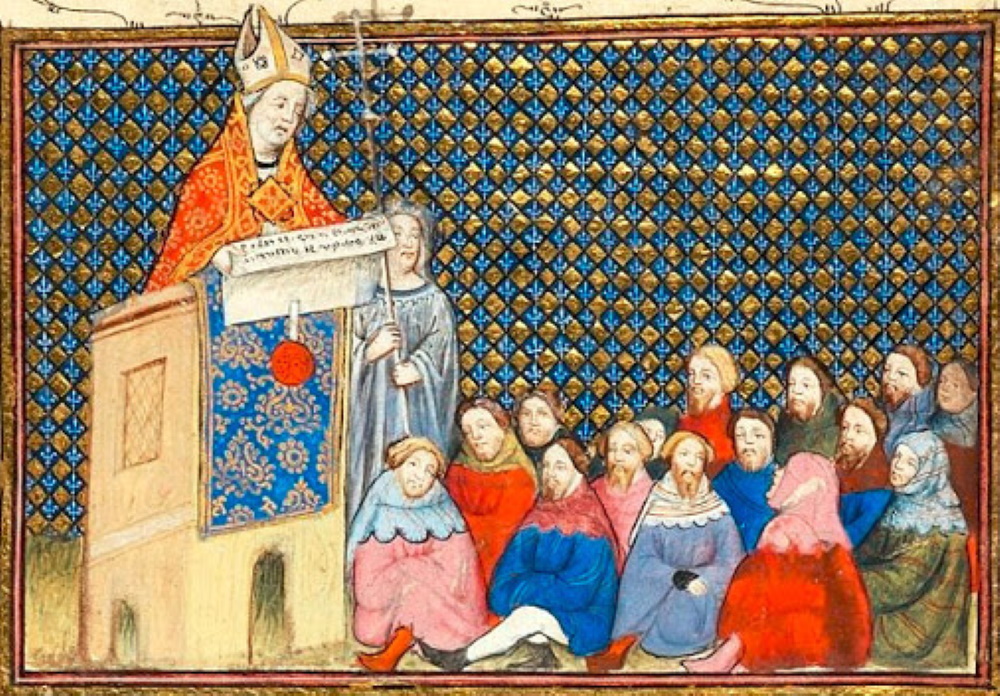
A list of mother churches and their subsidiary churches drawn up for Archbishop Lanfranc of Canterbury soon after his ordination in 1070 recorded a “chapel of ease” at “Nunningitun” that was a subsidiary church “Ad Wingeham” (to Wingham) . “Nunningitun” was then the name of the small hamlet where the chapel was located and not the name of the parish which only came into existence in 1282.
This record of a place of worship at “Nunningitun” in 1070 would appear to confirm that it was in use at the time of the Norman invasion in 1066 and, most likely, for many decades prior to the Normans arrival. However, a more exact date for the foundation of a place of worship at “Nunningitun” is as yet unknown.
Subsidiary churches were referred to as “chapels of ease” as they were originally built for the convenience, or ease, of parishioners who lived at a distance from the main church. The Church of St. Mary the Virgin at Wingham is some four miles or more to the north of the chapel of ease at “Nunningitun”. Unfortunately, the 1070 list does not record whether the subsidiary church at “Nunningitun” had been dedicated to St. Mary the Virgin by that time.
St. Mary’s Church is situated in the hamlet of Nonington, and the hamlet is on an ancient road that was almost certainly in use when Julius Caesar led his invasion of Kent. This ancient road links Eastry to Lyminge and beyond. The road heads west from Eastry to the hamlet of Rowling where it turns south-westwards along the valley bottom to progress through the settlements of Chillenden, Nonington, and Womenswold before bye-passing Barham to drop down into the Elham Valley and head along the valley through Elham to Lyminge. Beyond Lyminge the road continues on to Lympe, the Roman Portus Lemanis, also known as Lemanae, which served as a fort on the Saxon Shore, a settlement and a port.
Lyminge was the site of a high status settlement connected to the Kings of Kent from the late 5th to mid-7th centuries, and a convent was founded there in the early 630’s by Queen Æthelburh (Ethelburga), daughter of King Æthelberht I of Kent, and widow of Edwin, King of Northumbria.
This ancient road was obviously still of some importance in the early twentieth century as the section of road from Nonington to Lyminge and beyond was the route chosen to evacuate the inhabitants of Nonington in the event of an invasion of Kent by the German Kaiser’s Imperial Army during the early part of the First World War!
There was also a direct route from the hamlet of Nonington to Christ Church Priory in Canterbury. This route went via Old Court Hill to Christ Church’s manor at Adisham and then on across the Downs to Bekesbourne, where the Archbishop of Canterbury had a palace, before arriving at Christ Church Priory in Canterbury.
The chapel of ease at “Nunningitun” became a parish church in its own right when the Parish of Nonington was founded by Archbishop John Peckam in 1282:
From ‘The Chronicles of Wingham’ by Arthur Hussey
“On August 2nd 1282 Archbishop John Peckham founded the College of Wingham, a college of secular canons consisting of a provost and six canons, divided into four parishes as follows: Wingham; Esse (Ash); Godwyneston (Goodnestone) with the hamlets of Bonnington, Offington (Uffington in Goodnestone parish), Rolling, Newenham, underdone together with parts of Tuicham (Twitham, near Staple) and Chileden (Chillenden) and, lastly, the church of Nonington with the chapel of Wymelingewelde (Womenswold) and the hamlets of Rittlynge (Ratling), Freydeville (Fredville, almost certainly what was usually referred to as Holt Street), Hesol (Easole), Suthnonington (South Nonington, the hamlet around the church), Hakeholt (Ackholt), Catehampton (Kittington), Attedane (Oxenden, later Oxney ?), Wolshethe (Woollege, now part of Womenswold parish), and Vike (Wick, the exact location of which is not clear but was presumably near to the present Wick Lane and also now part of Womenswold) ‘some of which have been fixed in well-proportioned parts, which vicars are so far held without hindrance’.
On June 7th 1290 King Edward I gave his consent to the formation of the College. The six canonries were: Bonnington, Chilton, Pedding, Ratling, Twitham, and Wymlingswold (Womenswold), “so named after the places of their endowment”.
Church Visitation Rolls of 1294. From: Archaeologia Cantiana Vol 32, p 169.
“Nonyntone. The chaplain holdeth the Altarage and the fruits to farm, causes the tithes to be collected and manages everything. A year has elapsed since the wife of Robert Holestrete died. The chaplain has much land and busies himself much in secular affairs. There is no resident rector nor is anything known concerning any ordination (of a vicarage).As regard matrimonial causes the Provost investigates those that are to be wound up in the appointed manner.
Visitations are made in the church of Nonington, ect. By Thomas the Chaplain of the Church, and Ralph atte Bery, John Borfys, Robt. Acholt and Sampson atte Napiltone.
The missal is incomplete (insufficiens) as it was last year, and the church has not been repaired. Wherefore the parishioners are to be summoned to shew cause why they should not be compelled to pay the penalty, and they are again enjoined to repair the said defects under pain of 40s.
Also they lack a Matyrology, a manual and frontal for the alters in the nave of the church.
The nuns of St. Sepulchre, Canterbury, take tithes in the parish, by what right is unknown.
The abott and convent of St Alban’s take certain tythes, by what right is unknown, and they sold the same that year at one time and in gross (simul et in summa).
Thomas, the chaplain, holdeth the Altarage and all the fruits to farm.
The rectors do no alms in the parish.
John of Canterbury, chaplain, celebrating in the said parish hath no books and he is suspected of not saying matins and his service because he is a wandering fellow (vagabubdus). Nor is he careful to keep a record of his service (servicium suum recordando)”.
Archbishop Wareham’s visitation of 1511:
“CHAPEL OF NONYNGTON. The parishioners of Nonyngton exhibited a bill, stating that persons having lands and tenements within the said parish, refuse to share the burden of repairing the church with the inhabitants. Item, that some withdraw legacies bequeathed to the church, as in the bill.
The chaplain and parishioners say that the canons of the college withdraw £4 of annual pension belonging to the said chaplain”.
The chaplain in 1511 was Sir Roger Tolus or Tolns; the wardens were Richard Roger and Nicholas Andrew; whilst the leading parishioners were shown as John Boys, Robert Austyn, Stephen Deyll and Symon Quylter.
CHAPEL OF WYMONDLYNGWELD. The parishioners presented a bill against John Nethersall and Thomas Snoth, of Birham, stating that he withdrew the goods of the church, as appears by the bill”.
The chaplain in 1511 was John Cargill, the wardens were John Gorham and Thomas Best, whilst the leading parishioners were shown as William Goost and William Aden.
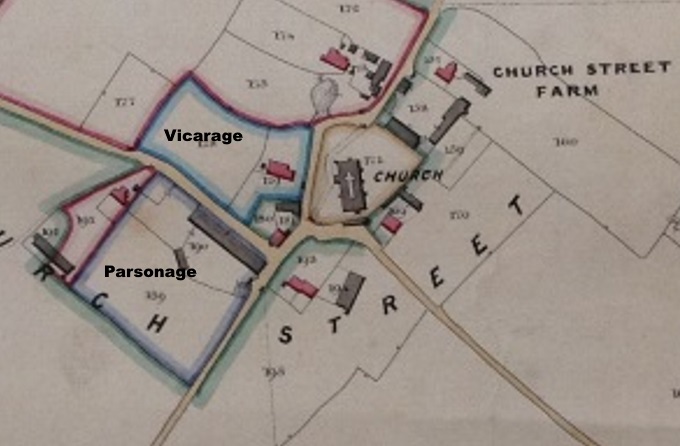
Nonington Church and its environs, an extract from the 1859 Poor Law Commissioners parish map.
A Topographie or Survey of the County of Kent. With some Chronological, Historicall, and other matters touching the same: And the several Parishes and Places therein by Richard Kilburne of Hawkhurst, Esquire. Published in 1659
“Nonnington:- Lieth about the middle of the East part of the County, about five miles (towards the southwest) distant from Sandwich, in the Bailiwick of Eastry, Lath of St. Augustine, East Division of the County, and division of Justices to that Lath. Part thereof in the Hundred of Eastry, and the residue in the Hundred of Wingham. The liberties of the late Archbishop of Canterbury and St. Augustine claim there, and the liberty of the late Dean of Canterbury claimeth over so much thereof as is within the Mannour of Eastry. It was all in the Deanery of Bridge and Diocess of Canterbury.
The Church standeth in the Hundred of Wingham, was called St. Maries, and was antiently a Chappel to Wingham, But in the year 1282 (upon dividing of Wingham into foure Parishes) this was one of them”.
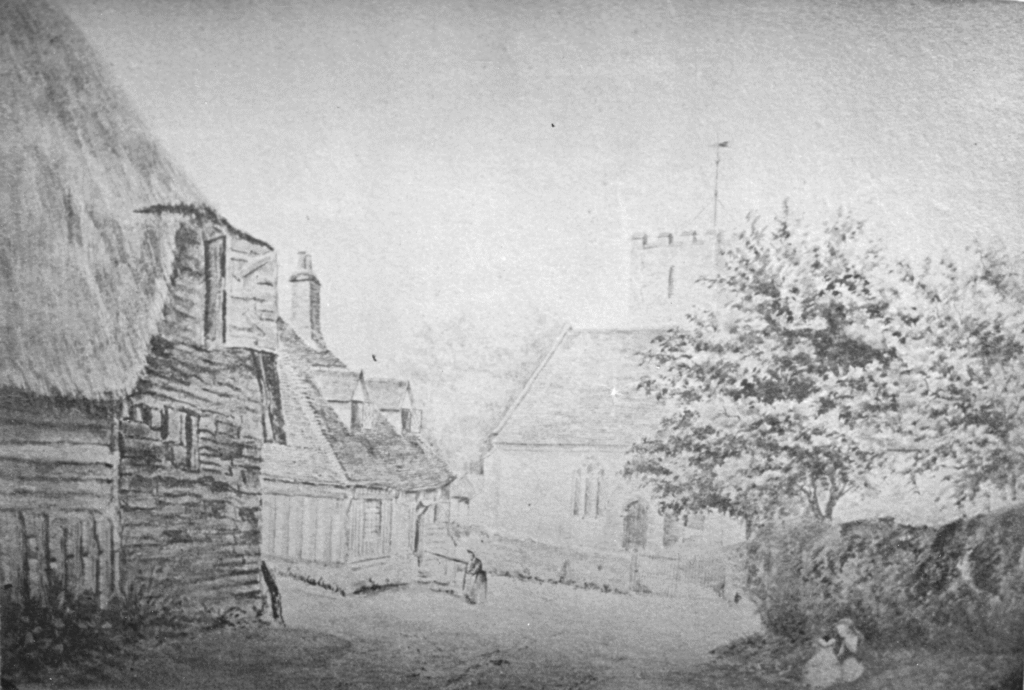
Nonington Church in the mid 1800’s, by an unknown artist. In the left foreground is the end of the Parsonage Tithe Barn which had a long frontage on Church Street and is marked in black on the extract from the 1859 Poor Law Commissioners parish map above. The barn’s site is now occupied by bungalows.
The History and Topographical Survey of Kent, volume IX by Edward Hasted, published in 1800.
NONINGTON:
“THIS PARISH is within the ECCLESIASTICAL JURISDICTION of the diocese of Canterbury, and deanery of Bridge.
The church, which is dedicated to St. Mary, consists of two isles and two chancels, having a tower steeple at the north corner at the west end, in which are three bells. In the south isle are the figures of a man between his two wives, traced on the stone, and inscription for John Hamon and Margaret and Mary his wives, obt. 1526. A memorial for Wm. Hammond, obt. 1717. In the south or high chancel, against the wall, a brass plate for Alicia, daughter and heir of William Sympson, esq. once marshal of Calais, and Catherine Gemecot, wife to Francis Wilford, obt. 1581. A stone, and inscription in brass, for John Cooke, vicar, obt. March 7, 1528. Several memorials for the Hammonds. In the north chancel, now made use of as a school, a memorial for Edward Boys, esq. obt. 1597. A monument for Mary, daughter of Edward Boys, and wife of J. Hole, obt.— Several memorials for Trotter and Wood. A monument for Sir John Mennes. In the windows of this church were formerly several shields of arms, long since destroyed; and the figure of a knight, kneeling on his surcoat, the arms of Boys, of Bonnington, and opposite to him the figure of a woman kneeling, and on her coat the arms of Roper. Another like figure of a knight, and on his surcoat the arms of Ratling, being Gules, a lion rampant or, an orle of Spears heads argent.
The church of Nonington was antiently a chapel of ease to that of Wingham, and was on the foundation of the college there by archbishop Peckham, in 1286, separated from it, and made a distinct parish of itself, (fn. 9) and then given to the college, and becoming thus appropriated to the college, continued with it till its suppression in king Edward VI.’s reign, when this parsonage appropriate, with the advowson of the vicarage or curacy of it, came into the hands of the crown, where it did not remain long, for in the year 1558, queen Mary granted it, among others, to the archbishop, but the rectory or parsonage appropriate, with the chapel of Wimlingswold appendant, continued in the crown till queen Elizabeth, in her 3d year, granted it in exchange, to the archbishop, when it was valued at thirty-three pounds, reprises to the curate 13l. 6s. 8d. At which rent it has continued to be leased out ever since, and it now, with the patronage of the curacy, remains parcel of the possessions of the see of Canterbury. William Hammond, esq. is the present lessee of the parsonage.
At the time this church was appropriated to the college of Wingham, a vicarage was endowed in it, which, after the suppression of the college, came to be esteemed as a perpetual curacy. It is not valued in the king’s books. The antient stipend paid to the curate as above, was, in 1660, augmented by archbishop Juxon with the addition of twenty pounds, but by the addition of Mr. Boys’s legacy of the small tithes in this parish and Wimlingswold, mentioned below, it is now, with that chapel, of the yearly certified value of 71l. 6s. 8d. In 1588 here were two hundred and thirty-five communicants.
Edward Boys, esq. of Nonington, by his will in 1596, gave towards the maintenance of a minister, being licenced and preaching every other Sunday at farthest at Nonington, yearly, for ever, all the profits of the small-tithes of Nonington and Wemingewell, (excepting those of the lands in his occupation, and the oblations and obventions due out of them, and the tithes of wood of all the lands and farms he had, or his heirs should have, within the parish) the said minister paying to him and his heirs the yearly sum of 40s”.

Nonington Church, an 1807 water-colour. The remains of an old wooden burial marker, used before the advent of cheap stone memorials, can be seen in mid picture. The Church Street forge is on the right, the site is now a car park.
The County of Kent by W.H.Ireland, volume 1, published in 1829
NONINGTON CHURCH:
“This edifice possesses monuments of the Hammond’s, the Boy’s, the Trotter’s and the Wood’s. In the window’s were formerly shields of armorial bearings in stained glass, &c. long since destroyed. This structure formerly ranked a chapel of ease to the church of Wingham; and, on the foundation of the college by Archbishop Peckham, separated from the same, and constituted a distinct parish then vested in that institution, and so remained till the suppression. By Queen Mary, in 1558, it was granted to the archbishop; but the rectory, with the chapel in Wimlingswold, continued vested in the crown till the 3d of Elizabeth, when it was granted in exchange to the primate of Canterbury, being valued at £33; reprises to the curate £13-6-8; at which rental it has continued to be leased, and remains part of the possessions of that see.
When this church was appropriated to the college of Wingham, a vicarage was endowed in the same, which, on the suppression of the college, was esteemed a perpetual curacy. It is not valued in the king’s books. The ancient stipend paid to the curate was in 1600 augmented by Archbishop Juxon, with an additional £20; but, by the addition of a legacy, bequeathed by Mr. Boys, of the small tithes in this parish and Wimlingswold, it became, with the chapel, of the annual value of £71-6-8. In 1588 there were 235 communicants in this parish”.
A Topographical Dictionary of England, by Samuel Lewis, 1848
“The living is a perpetual curacy, with that of Womenswould annexed; patron and appropriator, the Archbishop of Canterbury: the appropriate tithes have been commuted for £600, the perpetual curate’s for £250, and those of an impropriator for £170. The church is principally in the early English style”.

Nonington Church, painted on 16th October, 1867, by Wm F Saunders. To the right is the Church Street Forge