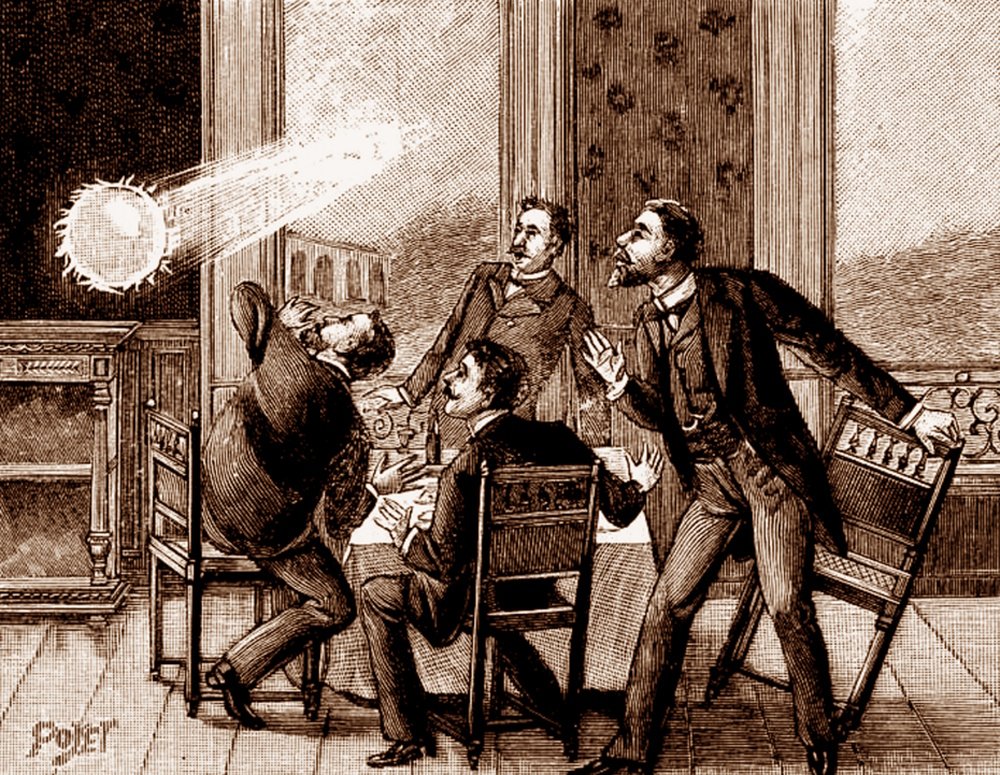
Further to my post “The Nonington Meteorite of 1910” regarding a supposed meteorite strike on the parish of Nonington in May of 1910 a reader of this post has kindly sent me a newspaper cutting which clarifies the nature of the phenomenon which occurred on Saturday, 24th May, 1910.
The following is a transcription of this cutting taken from the Kentish Express & Ashford News of May 28th, 1910:
THUNDERBOLT FALLS AT NONINGTON.
“During the storm on Saturday morning the remarkable sight of what is usually known as the fall of a “thunderbolt” was witnessed at Nonington. Mr. Cork, of the Forge, was stooping down attending to the horse of Mr. C. Morgan, veterinary surgeon, who was also watching the operation. Bushell, Mr. Cork’s assistant, was, however, standing, and as a heavy clap of thunder and vivid flash of lightning seemed to burst over the forge he looked out and saw what appeared to be a flame of fire rising from the ground in a large meadow opposite, belonging to Colonel Hammond. He drew Mr. Cork’s and Mr. Morgan’s attention to the spot, and all then saw a volume of smoke hanging over the ground. The dense darkness prevailing at the time added to the weirdness of the scene. Going afterwards to the spot they found a large hole where the ground had been first struck, and from this spot the earth was ploughed in several directions. The grass was also burnt for some distance around, and not only so, but quite large pieces of turf and earth were found uprooted and thrown yards out into the field. It was extremely fortunate that the spot was on open field, as the church, forge and cottages were at no great distance, where the consequences would have been extremely serious, both to life and property.“
The people referred to in the newspaper article are:
Mr. George Cork, the blacksmith at the Church Street forge, Bushell, first name unknown, the blacksmith’s assistant, and Mr. Charles Morgan, a veterinary surgeon and proprietor of the forge, who lived in the house next to the forge, now Church house.


The piece of ground that the fireball struck is in lower right of the photograph just across the road from Church House, the white building in the centre of the photograph. The land is now occupied by a house and three bungalows built in the early 1960’s. The photograph below was taken just after the forge was demolished in the late 1950’s but before the four dwellings were built. The site of the forge is now the car parking area with the post box next to the church wall
There is also reference to Colonel Hammond, this was in fact Captain Egerton Hammond of St. Alban’s Court in Nonington who owned the forge, Church House, and the surrounding land having inherited St. Alban’s Court house and estate on the death of William Oxenden Hammond, his uncle, in 1903.
There is a record of another fireball striking the old parish of Nonington prior to 1910, this occurred in 1741 at Ratling a mile or so to the north-west of the 1910 event.
“The Ratling Fireball:– On December 11, 1741, a fire-ball appeared soon after noon-day, and the sun shining, but few people saw it, and they could only guess at its course; which, however, was observed to be from north-west by north, to south and by south, and right over Littleborne from Westbere, and towards Ratling, near which place lord Cowper, who was hunting, heard but one explosion (for there were two); the other most probably happened at such a distance, as to be in one with that so near him. Mr. Gostling, of the Mint yard, who gave the account of it to the secretary of the royal society, says, that he found his house violently shaken for some seconds of time, as if several loaded carriages had been driving against the walls of it, and heard a noise at the same time, which he took for thunder, yet of an uncommon sound; though he thought thunder, which could shake at that rate, would have been much louder, therefore he concluded it to be an earthquake; the sky, he found, was cloudy, but nothing like a thunder cloud in view, and there was a shower of rain from the eastward presently after, the coldest that he ever felt”.

The 1741 and 1910 strikes were almost certainly ball lightning, an unexplained atmospheric electrical phenomenon and observers of it frequently refer to luminous, usually spherical objects, which vary in size from pea-sized to several meters in diameter. It is usually associated with thunderstorms but the phenomenon often lasts considerably longer than the split-second flash of a lightning bolt. Many historical reports refer to the ball exploding, often with fatal consequences to persons and livestock, and leaving behind the lingering odour of sulphur.